

Why Choose Us
One-stop Solution:
We provide perfect OR room solution,medical equipment solution and ICU monitor and therapy solution!
Competitive price:
Due to we are direct manufacturer,we can quote you our best price.
Professional Manufacturer:
The leading brand and the largest professional medical manufacture in China,with first and only one AI intelligent digital workshops and stock control in China.
Custom Service:
We accept your oem,with advanced ai intelligent stocks and workflows,we provide your the most professional and quickest delivery with 0 after service problem!
What is Dental Light
A dental curing light is a piece of dental equipment that is used for polymerization of light-cure resin-based composites.It can be used on several different dental materials that are curable by light.the light used falls under the visible blue light spectrum. this light is delivered over a range of wavelengths and varies for each type of device. there are four basic types of dental curing light sources:tungsten halogen, light-emitting diodes (LED),plasma arcs,and lasers.the two most common are halogen and LEDs.
-

Dental LED Operatory Light
YUDA's surgical and examination lights are both customisable and energy-efficient. We sell the Add to Inquiry -
Dental Shadowless Operation Lamp
Halogen Examination dental oral implant Lamp, Mobile Stand This lamp is specially designed for Add to Inquiry -
LED Dental Oral Implant Lamp
LED dental oral implant lamp. Light body is light, it can be used for both surgical lighting and Add to Inquiry -
Oral Dental Operation Light
We are leading and professional manufacturer on operating equipment, hospital furniture, ICU Add to Inquiry -
Outpatient Dental Implant Lamp
As an innovator and a pioneer in modern shadowless operation light and dentistry dental implant Add to Inquiry -
Medical Dental Exam Lamp
YFE350 is an Implant Surgery Lamp Oral Operating Light For Dental Unit Chair,Ceilings,Walls And Add to Inquiry -
Dentistry Lamp
YFE350 is an Implant Surgery Lamp Oral Operating Light For Dental Unit Chair,Ceilings,Walls And Add to Inquiry -
Dental Ceiling Light
YFE320 is an advanced new LED dental implant lamp. It offers flexibility and multiple future Add to Inquiry -
Dental Chair Light
LED DENTAL IMPLANT LAMP,YFE320 is a new type dental implant lamp, it blongs to STARRY series Add to Inquiry -
LED Dental Operating Light
YDE200 LED dental implant lamp is a classical dental lamp with sensor touch, it adopts aluminum Add to Inquiry -
Online Shopping Dental Lamp
BEST DENTAL Manufacture – high valued products for your Dental Office and Laboratory! For daily use Add to Inquiry -
Dentistry Surgical Examination Lights
Get the best deals on Dentistry Surgical & Examination Lights when you shop the largest online Add to Inquiry


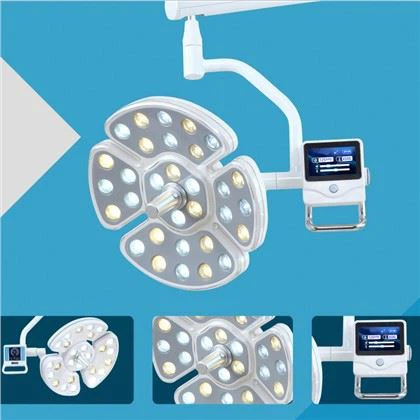


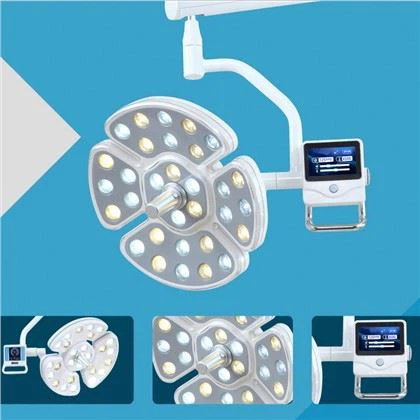

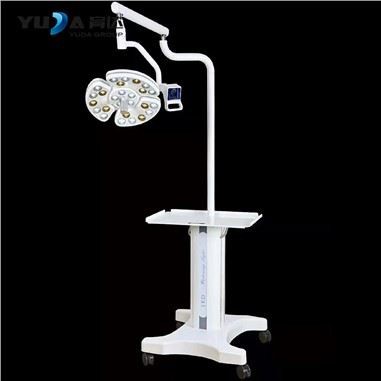
Benefits of Dental Light
Convenience:
The availability of portable led headlight makes it more convenient for practitioners to perform various dental procedures and clinical exams.
Reduce eye fatigue:
Being able to see things clearly helps you avoid getting eye fatigue or strain.
Correct color matching:
With the right type of led beam color,you can be able to identify the true and natural color of the oral cavity and the teeth of your patients without any color distortion.
Improved work performance:
With the proper source of light and right magnification level,you can be able to lift your work performance a few notches higher.
What are the Applications of Dental Light
Dental lights are mainly used in the field of oral medicine,including oral examination, oral surgery,dental restoration,dental beauty, etc. during oral treatment,the doctor needs to carefully examine and operate the patient's oral cavity.

Types of Dental Light
1

Tungsten halogen:
One of the early dental curing lights is the tungsten halogen curing lights.developed in the 1980s,they have been the replacement of uv lights by utilizing the blue wavelength.to generate the light,the halogen bulb needs to be energized..
2
Plasma arcs:
A fluorescent bulb that contains plasma generates a light source of high intensity.according to the claims,within just 3 seconds,the resin composite material will becured.
3
Lasers:
If you are familiar with argon lasers,they are usually used for medical practices. more commonly,you might have encountered that procedure in an eye clinic. due to its effectiveness in generating such a focused light source,it is seen as effective for dental curing light.
4
Leds or light-emitting diodes:
And here comes the newcomer,the light-emitting diode or led.this semiconductor component is capable of emitting a wide spectrum of light without wasting energy in generating heat or having an expensive operating cost.
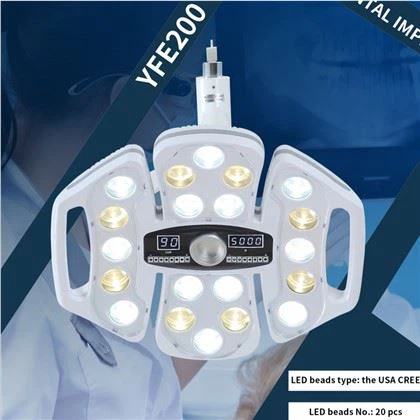
Material of Dental Light
The four types of light-curing units that are currently available include quartz-tungsten-halogen (QTH),light-emitting diode (LED),plasma arc curing (PAC), and Argon laser units.QTH light-curing units are the most widely used and are made of a quartz bulb containing a tungsten filament in a halogen environment.
Features of Dental Light
Adequate brightness, to reduce eye fatigue.optimal color rendering, to ensure accurate diagnosis.easy ergonomic positioning, to support healthy posture by reducing clinician movement.
How dental curing lights work
Depends on converting individual resin monomer units into connected polymer chains,thereby decreasing the viscosity of the resin material until it becomes solid. this process is initiated by molecules called photoinitiators,which generate free radicals when they absorb light of a specific wavelength. the free radicals interact with the resin monomers to change their chemical bonds so that they can link to each other,releasing more free radicals in the process to help the conversion continue throughout the material. the higher the degree of conversion,the more durable the resulting restoration.

How to maintain Dental Light
01/
Cleaning: Dental loupes are explicit optical instruments and must have anti-reflective coating on the optics to amplify the experience.you must conduct cleaning with proper care to ensure longevity.use a can of compressed air to eliminate dirt particles and foreign debris.use the lens cleaner with a microfiber cloth to clean the optics.
02/
Aover with a lens cap: Protect the lens of your loupe by covering and safeguarding it with a lens cap all the time,and it will safeguard the lenses against damage and scratches. you can purchase them from any local optical store.
03/
Battery life: Two types of headlights are available in the market - one is wired, and the other is a wireless dental headlight. both of them work with a rechargeable battery system,which can be charged anytime as needed. usually,the batteries have a running time of approximately 9-20 hours and work very well.
04/
Preventive measures: We know that we cannot go to the repair shop or optical store for small things,so it is imperative to have an extra pair of loupe screws with you to use whenever you need a quick repair.
certificate
CE with globally exporting support---TUV, NQA, FDA, Russia CE
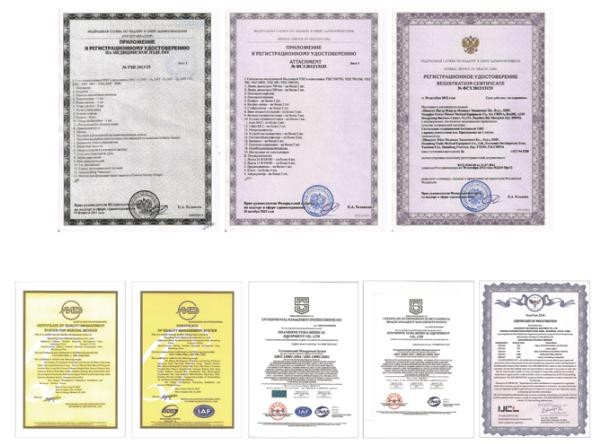
Presentation of cooperation cases


FAQ
Q: What is the maintenance and disinfection requirements for a dental light?
A: Curing lights should be cleaned after every use. This includes changing the infection control barrier, using a disinfectant wipe on the entire light and conducting proper sterilization (either by using an autoclave or another acceptable method).
Q: How do you turn off a dental light?
A: You can use the controls located on the light or on an A-dec touchpad to operate the dental light. Move your hand within 3" (76 mm) below the sensor to turn the light on or off. NOTE Black gloves may impact the sensor's ability to activate the dental light.
Q: What is the best light source in dentistry?
A: They are also low to no heat emitting which is ideal for exam rooms where you want to create as comfortable of an environment as possible. If you already have fluorescent fixtures in place, the best part is that most fixtures can be upgraded to LED lamps with ease.
Q: Are dental curing lights UV or LED?
A: The three curing lights featured in this story are as follows: tungsten halogen, light-emitting diode (LED), and plasma arc curing (PAC). However, the most widely used by dentists are the halogen and LED versions.
Q: What is the depth of a dental light curing?
A: A standard exposure time using most dental curing lights is 20 seconds. In general, this is sufficient to cure a light shade of resin to a depth of 2 or 2.5 mm, assuming that the light guide is immediately adjacent to the restoration surface.
Q: What is dental lighting?
A: Dental lights allow you to identify details, match tooth shades, and evaluate and perform procedures all while reducing eye strain. Henry Schein Dental advisors will guide you in your review of halogen and LED dental operatory lights.
Q: What is dental LED curing light?
A: Photoactivated dental materials, including certain sealants, resin-based cements and composite restorative materials, are an integral part of general dental practice. Dental light curing units (LCUs) are handheld light-emitting devices used to cure such photoactivated, polymer-based restorative materials (PBRMs).
Q: What are the different types of dental lights?
A: There are four basic types of dental curing light sources: tungsten halogen, light-emitting diodes (LED), plasma arcs, and lasers. The two most common are halogen and LEDs.
Q: What is the function of dental light in dental chair?
A: The dental or operator light is used to illuminate inside the mouth or oral cavity of the patient seated on the dental chair. It is usually positioned 30-50 inches from the mouth of the patient to avoid the light from shining in the patient's eyes and causing discomfort.
Q: What kind of light do dentists use?
A: The blue light we often see our dentists use is called a dental curing light. The majority of dentists today use LED curing lights to set fillings and sealants. When you have a cavity, your dentist removes the tooth decay with a drill and prepares the tooth for a dental filling.
Q: Are dental lights UV?
A: It's in the blue wavelength range. True UV light isn't visible to humans, while dental curing lights are. Lights used nowadyas, in dentistry are not the UV lights as they are harmful for eyes. The new light system emit intense visible light for curing of dental composite.
Q: Is dental curing light safe?
A: Dental Curing Lights are completely safe. There is no radiation, and although concentrated, the blue light is not a laser or strong enough to hurt your teeth or gums. Because it's super bright, the dentist will probably make you wear a form of eye protection.
Q: Why do dentists use yellow light?
A: Newer models of overhead dental chair lights with LED have settings that use the yellow spectrum of light instead of blue during the curing process. This is an important factor to prevent premature curing of the dental composite.
Q: Is a dental curing light a laser?
A: Lasers have been used in dentistry for years, including soft-tissue and larger laser curing devices. While some dentists are concerned with the heat intensity when using a laser to cure composite, all research shows lasers are completely safe. Tissue damage can occur when pulp tissue temperature increases by 5.5° C.
Q: Can you wash away LED Dental Light?
A: While washing with soap and water is often a sufficient means of removing lead residue, there are more efficient cleaning products that can almost completely eliminate lead content from your skin. Decontamination towels, for example, remove 98 percent of lead residue from skin.
Q: What is dental lighting?
A: Dental lights allow you to identify details, match tooth shades, and evaluate and perform procedures all while reducing eye strain. Henry Schein Dental advisors will guide you in your review of halogen and LED dental operatory lights.
Q: What is the light on the dental chair called?
A: The dental or operator light is used to illuminate inside the mouth or oral cavity of the patient seated on the dental chair. It is usually positioned 30-50 inches from the mouth of t
Q: What does a dental operating light do?
A: A dental operatory light is a surgical task light that is used for oral cavity illumination during a dental examination, treatment, or surgery. Dentistry usually encompasses a broad range of practices related to the oral cavity.
Q: What is the best light for dentistry?
A: LED lighting is by far the most popular choice among operator lights for dental loupes. LED lights give cool, white light and last much longer than halogen.
Q: Why yellow light is used in dental chair?
A: Newer models of overhead dental chair lights with LED have settings that use the yellow spectrum of light instead of blue during the curing process. This is an important factor to prevent premature curing of the dental composite.
